
1. Introduction
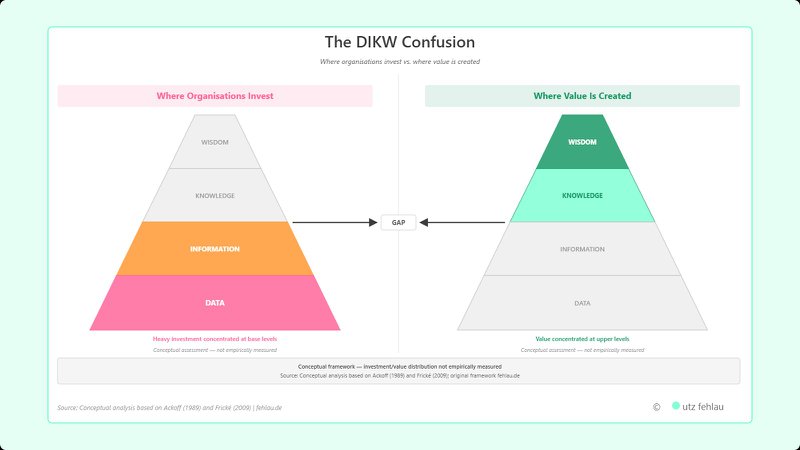
Imagine a scenario familiar to many mid-sized businesses. A manufacturing company with 180 employees invests eight months and substantial resources in a new document management system. The implementation goes smoothly. The rollout follows the plan. Twelve months later, actual system usage sits at 17 per cent. The internal diagnosis: 'The system is too complex.' The accurate diagnosis: the company organised information but ignored knowledge. It intervened at the wrong level of the DIKW hierarchy — and lacked a framework to recognise the mistake.
This is not an isolated case. Organisations across industries consistently misdiagnose knowledge management problems because the dominant conceptual model — the DIKW pyramid — provides insufficient guidance. The model identifies where you want to go but not how to get there, not why you might get stuck, and not which forces are pulling you in the wrong direction.
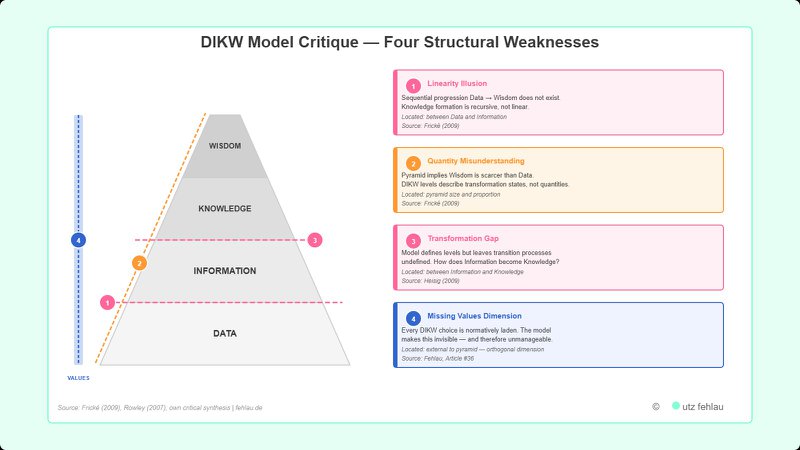
The DIKW pyramid — Data, Information, Knowledge, Wisdom — is the most widely used mental model in knowledge management. It is also one of the most systematically misunderstood. Three structural weaknesses produce recurring misallocations in practice.
First, the linearity illusion. The model implies a sequential progression from data to wisdom that does not exist in cognitive or organisational reality. Knowledge does not emerge through simple distillation of information; it emerges through interpretation, experience, and contextual judgement (Frické, 2009).
Second, the transformation deficit. The model defines levels but leaves the processes between levels conceptually undefined. What specific organisational conditions enable the transformation from information to knowledge? The silence on this question has direct practical consequences.
Third, the missing values dimension. Every decision about which data to collect, which information to classify as relevant, and which knowledge to prioritise is a normative choice. The classical DIKW model makes this normative dimension invisible — and therefore unmanageable.
The consequences are measurable. Empirical reviews of KM initiatives consistently document high failure rates across organisations of all sizes, with a substantial proportion attributable to conceptual misalignment between the diagnosed problem and the implemented solution. Heisig's (2009) global analysis of 160 KM frameworks found that most frameworks describe knowledge activities but provide limited guidance on transformation processes — a gap that systematically generates ineffective interventions. Organisations invest in the wrong level because they cannot precisely locate their actual deficit.
This article addresses that gap. Building on the epistemological foundations of knowledge management established in the preceding article in this series (Fehlau, Article #35), and extending the foundational definitions of organisational knowledge (Fehlau, Article #6), it proposes the DIKW-V model — an extended framework that integrates a values dimension and a knowledge transformation cycle into the classical hierarchy.
After reading this article, you will be able to: (1) identify the four structural weaknesses of the classical DIKW model; (2) apply the proposed DIKW-V framework as a diagnostic instrument; (3) locate your organisation on the DIKW-V scale; and (4) derive targeted interventions for identified bottlenecks.
2. Conceptual Foundation
2.1 Core Definitions
The DIKW model operates with four distinct concepts. Precision matters here because organisations frequently conflate adjacent levels — particularly information and knowledge — generating interventions that address the wrong problem.
Data are raw, uncontextualised facts without inherent meaning. The number '127' is data. Data carry no significance until placed in a context that enables interpretation. DIN ISO/IEC 2382 (2015) defines data as 'reinterpretable representations of information in a formalised manner suitable for communication, interpretation, or processing' — a definition that deliberately withholds any claim about meaning or utility.
Information is contextualised data. '127 support requests in March, 23 per cent more than the previous month, primarily concerning Feature X' is information. Context transforms data into something an observer can interpret and potentially act upon.
Knowledge is interpreted information, connected to experience and organisational context. 'Feature X consistently generates errors for specific user profiles — based on evidence from three similar rollouts' is knowledge. This statement integrates pattern recognition, historical comparison, and causal inference. It cannot be derived from information alone; it requires the application of experience and judgement.
Wisdom is strategically and ethically reflected application of knowledge. 'We decide to temporarily deactivate Feature X, despite short-term revenue costs, because long-term customer retention is strategically more valuable' is wisdom. Wisdom integrates knowledge with values, priorities, and long-term perspective to produce actionable judgement under uncertainty.
2.2 Historical Context
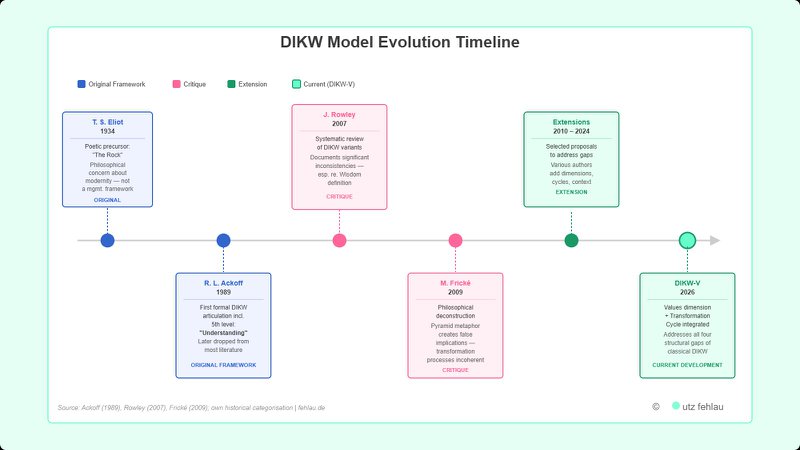
The DIKW framework has a history that is frequently oversimplified. T. S. Eliot's 1934 verse in The Rock — 'Where is the wisdom we have lost in knowledge? Where is the knowledge we have lost in information?' — represents a poetic precursor, not a formal model. Eliot was registering a philosophical concern about modernity, not proposing a management framework.
Russell Ackoff (1989) provided the first formal articulation in the Journal of Applied Systems Analysis. Critically, Ackoff's original model included a fifth level — Understanding — positioned between Knowledge and Wisdom. This element was largely dropped in subsequent literature, creating a subtle conceptual gap that later critics would identify as significant.
Jennifer Rowley's (2007) systematic review in the Journal of Information Science documented the diversity of DIKW interpretations across academic literature and identified significant inconsistencies in how Wisdom, in particular, was defined — ranging from 'applied knowledge' to 'moral and ethical understanding.' Rowley's analysis demonstrated that the DIKW model is not a unified, coherent framework but a family of related interpretations with important divergences.
Martin Frické (2009) offered the most philosophically rigorous critique to date, arguing that the pyramid metaphor creates false implications about the quantitative relationship between levels, and that the transformation processes between levels are conceptually incoherent in most DIKW formulations.
2.3 Connection to Knowledge Management Practice
The DIKW model serves a primary diagnostic function in knowledge management: it helps organisations identify where their knowledge problem actually resides. This diagnostic function operates across four application domains.
Problem identification: At which level does the actual knowledge deficit exist? An organisation that cannot locate expertise is suffering from an information problem — poor search and classification architecture — not a knowledge problem. An organisation whose experienced employees repeat the same mistakes is suffering from a knowledge transfer deficit, not a documentation deficit.
Resource allocation: Different DIKW levels require fundamentally different interventions. Data problems require taxonomies, metadata systems, and classification standards. Information problems require search architecture and navigation design. Knowledge problems require social infrastructure — communities of practice, mentoring, and structured reflection. Wisdom problems require cultural and leadership interventions. Mismatching tool type to problem level cannot be compensated by better execution.
Process design: Which transformation processes require organisational support? The transitions between levels are not automatic. They require specific conditions, instruments, and social structures. KM strategy must address these transitions explicitly rather than assuming they occur naturally.
Epistemological positioning: The connection to philosophical foundations is direct. An objectivist perspective treats the DIKW hierarchy as an objective taxonomy: data, information, and knowledge exist independently of observers and can be captured and transferred with sufficient precision. A constructivist perspective treats DIKW as a socially constructed meaning framework: what counts as knowledge depends on who is doing the interpreting, in what context, and for what purpose (Fehlau, Article #35). This distinction has substantial practical implications for KM system design that organisations frequently overlook.
If you want a deeper explanation of why hidden epistemological assumptions silently shape KM system design and adoption outcomes, seePhilosophical Foundations of Knowledge Management
2.4 Current Relevance
Artificial intelligence operates primarily at the Data and Information levels. AI systems identify patterns in large datasets, classify inputs, and generate information outputs with high efficiency. The transformation from information to knowledge — integrating contextual judgement, causal reasoning, and experiential pattern recognition — remains fundamentally human. This distinction matters acutely for organisations designing AI-augmented KM systems.
Information overload, documented by Davenport and Beck (2001) as a structural feature of contemporary organisational life, intensifies transformation demands at all levels. More data does not automatically generate more knowledge; without effective transformation processes, it generates more noise.
Remote and hybrid work removes informal transformation channels. The corridor conversation, the shared working session, the spontaneous whiteboard exchange — these are not peripheral to knowledge management. They are primary mechanisms by which information becomes knowledge in organisational settings. When these channels disappear, organisations must make their transformation processes explicit or accept knowledge loss (Intezari & Gressel, 2017).
3. Framework and Methodology
3.1 Critical Analysis of the Classical DIKW Model
The four structural weaknesses of the classical DIKW model require systematic examination before any extension is proposed. Understanding the nature of each weakness clarifies both why the extension is necessary and what form it should take.
The Linearity Illusion
The pyramid metaphor implies sequential progression: data enters at the base, proceeds upward through processing stages, and emerges as wisdom at the apex. This implication is philosophically incoherent (Frické, 2009).
Cognitive and organisational knowledge-creation processes are recursive, not linear. A manager interpreting financial data does not proceed mechanically from data to information to knowledge in sequence. She simultaneously applies existing knowledge frameworks to interpret data, questions whether her interpretation generates new information demands, and revises her knowledge structure based on patterns she notices. The process operates in multiple directions simultaneously.
More fundamentally, knowledge is not a 'concentrated' or 'refined' form of information. It is a different kind of thing. Information is propositional — it can be stated in declarative sentences. Knowledge is dispositional — it is a capacity to recognise, judge, and act appropriately in context. You cannot create organisational knowledge by generating more information. You can only create the conditions under which people develop knowledge through experience and reflection.
The Quantity Misunderstanding
The pyramid format visually implies that wisdom is scarcer than knowledge, which is scarcer than information, which is scarcer than data. This implication is conceptually incorrect in two respects.
First, the DIKW levels do not describe quantities. They describe transformation states — the same content can exist simultaneously at multiple levels depending on who is engaging with it and in what context. A sales report is data for an operations analyst and actionable knowledge for an experienced account manager who has recognised the same pattern twenty times before.
Second, more data does not generate more wisdom through any automatic process. Organisations that have implemented large-scale data collection without investing in transformation infrastructure consistently discover this: they possess more data than ever and understand their operations less clearly than before (Davenport & Beck, 2001).
The Missing Values Dimension
Every choice in the DIKW process is normatively laden. Which data are collected? Which information sources are considered authoritative? Which knowledge is prioritised for documentation and which is allowed to atrophy? Whose judgement counts as wisdom? These questions are not answered by the DIKW framework. They are answered by organisational values — explicitly or implicitly, consciously or unconsciously.
When the normative infrastructure of a KM system is invisible, it cannot be examined, challenged, or intentionally designed. Organisations discover their values dimension only when it fails: when two departments collect contradictory data because they operate with different implicit standards, or when a KM system is never used because it embodies values that employees do not recognise as their own.
This is also why compliance-driven KM programs often create “document repositories” that technically exist but remain culturally unused—seeMandatory Exercise or Sustainable Knowledge Culture?.
The Transformation Gap
The model describes levels but does not specify the mechanisms that enable transitions between them. How does information become knowledge in an organisational setting? Under what conditions does this transformation succeed, and under what conditions does it fail?
The silence on this question generates a specific and common failure mode: organisations diagnose a knowledge problem correctly — they recognise that they are at the Information level when they need to be at the Knowledge level — but implement the wrong intervention. They generate more information documentation instead of creating the social conditions for knowledge development. Heisig's (2009) global analysis of 160 KM frameworks found that most frameworks describe knowledge types and knowledge activities but provide limited guidance on transformation processes — a finding that corroborates the practical significance of this gap.
A practical way to make this gap actionable is to use an explicit process model (Capture–Organize–Distill–Express), outlined inThe CODE Principle — Sustainable Knowledge Management for SMEs.
3.2 The Extended DIKW-V Model (Proposed Framework)
| Author's Note on Framework Status The DIKW-V model is a conceptual extension proposed in this article. It is not an established academic standard and has not yet been subjected to empirical validation. Throughout this article, it is consistently framed as a proposed framework. Its empirical validation remains a task for future research. What it offers is conceptual precision that the classical model lacks and a diagnostic vocabulary that practitioners can apply immediately. |
|---|
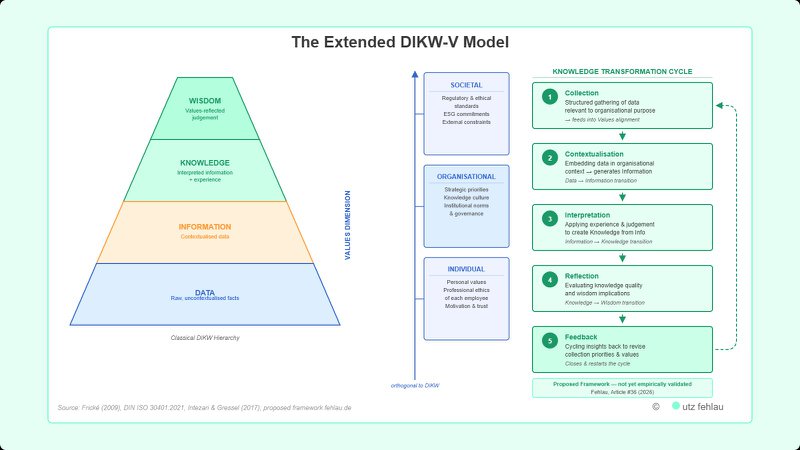
Building on established criticism of the DIKW pyramid (Rowley, 2007; Frické, 2009) and on research into the relationship between information systems and organisational decision-making (Intezari & Gressel, 2017), this article proposes an extended framework — the DIKW-V model — designed to address the four identified weaknesses. The extension operates through three structural components.
Component 1: Integration of the Values Dimension
Values in the DIKW-V model is not a fifth level above Wisdom. It is an orthogonal dimension that intersects all four levels simultaneously. This distinction is fundamental: values do not represent a higher form of wisdom. They represent a different kind of thing — a normative infrastructure that shapes how the organisation operates at every level of the hierarchy.
The proposed values dimension comprises three sub-levels. Individual values describe what each employee considers important, worth protecting, and worth investing effort in. These values determine which informal knowledge-sharing conversations actually happen — independent of any formal KM system. Organisational values describe what the company as an institution prioritises. These values determine which knowledge is systematically captured and which is allowed to disappear. Societal values include regulatory requirements, ethical standards, and sustainability commitments that create external normative constraints on knowledge practice (Arieli, Sagiv, & Roccas, 2019).
Consider a practical illustration. Two companies with identical datasets, identical information systems, and equally capable employees make different strategic decisions. The classical DIKW model cannot explain this difference. The proposed DIKW-V model can: the values dimension of the two organisations is configured differently, generating different answers to the normative questions embedded in every DIKW transformation.
Component 2: Processualization — From Hierarchy to Transformation Cycle
The DIKW-V model replaces the static pyramid metaphor with a dynamic transformation cycle. The Knowledge Transformation Cycle proposed here comprises five stages: Collection (structured gathering of data relevant to organisational purpose), Contextualization (embedding data in organisational context to generate information), Interpretation (applying experience and judgement to create knowledge from information), Reflection (evaluating knowledge quality and wisdom implications), and Feedback (cycling insights back to revise collection priorities and values alignment).
This cycle is explicitly non-linear. Reflection generates new Collection requirements. Interpretation reveals gaps in Contextualization. The Feedback loop connects the cycle's outputs to the Values dimension, enabling organisations to recognise when their operational knowledge practice has drifted from their stated values — and to correct the drift intentionally (Intezari & Gressel, 2017).
A practical approach to keeping knowledge assets current (instead of running infrequent, catch-up audits) is described inContinuous Knowledge Auditing.
Component 3: Norm-Compatible Conceptual Precision
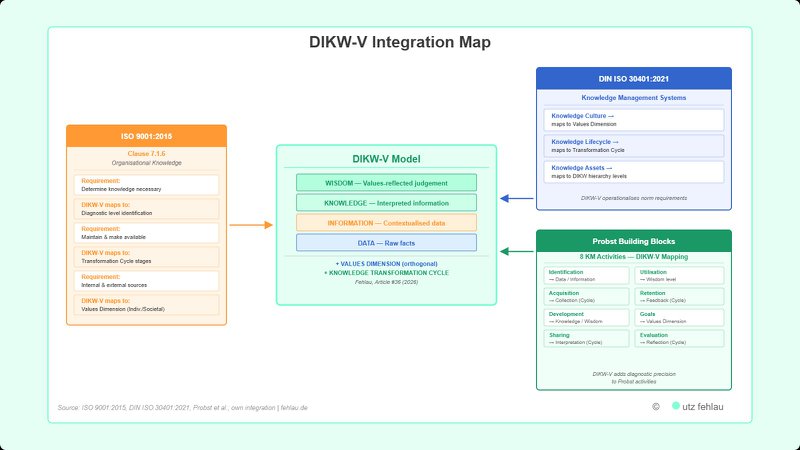
DIN ISO 30401:2021 conceptualises organisational knowledge as an asset that enables effective decisions and actions in context, and frames knowledge management as encompassing knowledge culture, governance, and lifecycle management. The proposed DIKW-V model is compatible with this conceptual territory. The standard's 'knowledge culture' requirement maps to the Values dimension; the standard's 'knowledge lifecycle' concept corresponds to the Knowledge Transformation Cycle. For SMEs working toward DIN ISO 30401:2021 alignment, the DIKW-V model provides an implementation pathway that operationalises the norm's requirements with diagnostic specificity.
3.3 Implementation for SMEs
The DIKW-V model's diagnostic power is most directly realised through three operational applications in SME contexts.
Diagnostics: Identifying the Right Level
The first application is systematic diagnosis of knowledge deficits. SMEs commonly misdiagnose their knowledge problems — not through lack of analytical capacity, but because they lack a precise vocabulary for distinguishing DIKW levels. The symptom table below provides a structured entry point for team-level diagnostics.
| "We don't know what we have" | Data | Unstructured storage; missing asset inventory | Knowledge inventory; data mapping |
|---|---|---|---|
| "We can't find anything" | Information | Missing taxonomy; unclear filing logic | Metadata systems; search optimization; tagging |
| "We keep making the same mistakes" | Knowledge | Experiences not systematically shared or reflected | Lessons learned processes; communities of practice |
| "We make poor decisions" | Wisdom | Absent reflection culture; time pressure dominates | Reflection spaces; decision journals |
| "We don't know what matters" | Values | KM without strategic alignment; priority conflicts | Strategy workshops; values clarification |
Table 1: DIKW-V Diagnostic Framework. Source: Own development based on the proposed DIKW-V model.
Designing Transformations
The second application addresses the three critical transformation transitions, each requiring different organisational instruments.
Data to Information requires structural interventions: tagging systems, classification standards, metadata architecture, and controlled vocabularies. The goal is systematic contextualisation — ensuring that data can be found, compared, and interpreted by someone other than the person who collected it.
Information to Knowledge requires social interventions: interpretation workshops, knowledge cafés, communities of practice, mentoring relationships, and structured after-action reviews. Documentation cannot substitute for this work. Documents carry information; they cannot carry the interpretive capacity that transforms information into knowledge.
For the human drivers behind knowledge transfer (trust, motivation, psychological safety), seePsychological Foundations of Knowledge Sharing.
Knowledge to Wisdom requires cultural and leadership interventions: dedicated reflection spaces, decision documentation practices, ethical discourse formats, and strategy development processes that integrate lessons learned. Wisdom cannot be mandated or incentivised in the conventional sense; it requires organisational conditions that make reflection possible and professionally valued.
Avoiding Common Pitfalls
Three failure modes recur with sufficient regularity to warrant specific identification.
Technology fixation: Implementing a document management system to solve a knowledge problem. DMS tools are well-suited to Information-level challenges. They cannot address Knowledge-level deficits, because knowledge is not primarily a retrieval problem — it is an interpretation and application problem.
Process documentation is valuable—but it mainly addresses Information-level needs; a practical guide isProcess Documentation: Unlocking the Power of Knowledge Management.
Over-documentation: Attempting to force tacit knowledge into explicit documentation. Some forms of organisational knowledge resist explicit representation — not because they are mysterious, but because the representational cost exceeds the value recovered. Exhaustive documentation mandates generate compliance theatre, not knowledge transfer.
Values blindness: Implementing KM systems without examining the organisational values that will determine whether anyone uses them. A KM system designed around efficiency values will not be adopted by employees whose primary values are professional expertise and autonomy. The system and the culture must be aligned — and this alignment cannot be achieved by system design alone.
4. Analysis and Application
4.1 Diagnostic Patterns
Organisations rarely present with isolated DIKW-V deficits. Four composite patterns emerge with sufficient regularity to serve as diagnostic templates for SME practitioners.
Pattern A — Data-Rich, Knowledge-Poor: Extensive documentation exists, but employees do not internalise or apply it. This pattern is common in ISO-certified SMEs with comprehensive quality management manuals that sit unread in digital archives. The presenting symptom is process noncompliance despite documented procedures. The actual problem is investment at the Information level while the Knowledge transformation infrastructure is absent. More documentation will not solve it.
Pattern B — Knowledge Islands: Expertise exists but remains person-specific and fragmented. This pattern characterises owner-managed SMEs with long-tenured employees. Individual departments maintain functional knowledge unavailable to other parts of the organisation. The Values dimension is typically implicated: in organisations where expertise is a source of status and occupational security, employees have rational incentives not to share knowledge. KM system design that ignores this normative reality will fail regardless of technical sophistication.
A useful field method to locate where expertise actually lives (and where flow breaks) isKnowledge Gemba Walks.
Pattern C — Wisdom Deficit: Operational excellence coexists with strategic weakness. Organisations in this pattern execute well but do not reflect on whether they are executing the right activities. They accumulate experience without converting it into organisational learning. The Knowledge Transformation Cycle is truncated: Reflection and Feedback are absent, and the cycle does not complete.
Pattern D — Values Disconnect: A functional KM system exists but is not used. This pattern commonly follows top-down KM implementations not preceded by organisational values work. The system embodies management values — efficiency, documentation, auditability — that are not shared by the intended users. The diagnostic insight is that values clarification must precede system design, not follow it.
4.2 Action Planning
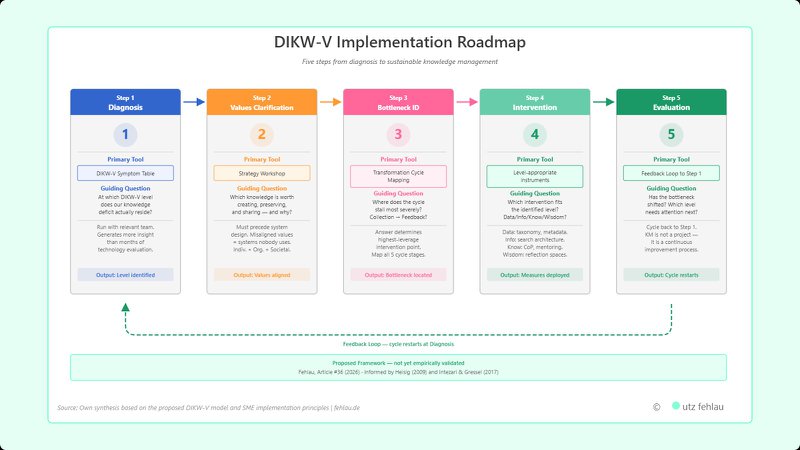
The proposed DIKW-V model generates a four-step prioritisation logic for SMEs seeking to implement or improve their knowledge management practice.
Step 1 — Values clarification first. Without organisational clarity about what knowledge is worth creating, preserving, and sharing — and why — KM investments have no strategic direction. This step is frequently skipped because it appears abstract. Its consequences are concrete: misaligned systems that no one uses.
Step 2 — Identify the primary bottleneck. Where does the knowledge transformation cycle stall most severely? Is the primary problem at Collection, Contextualisation, Interpretation, Reflection, or Feedback? The answer determines which interventions have the highest leverage.
For a pragmatic, SME-friendly method to visualize where knowledge is stored, who owns it, and where it gets stuck, seeMapping the Data Terrain.
Step 3 — Plan quick wins. Which low-resource interventions address the primary bottleneck directly? For a Knowledge-level bottleneck, a bi-weekly lessons-learned session costs almost nothing and generates immediate value. Selecting quick wins that demonstrably align with the values clarification builds organisational trust in the KM initiative.
Step 4 — Build long-term capacity. Which structural prerequisites must be created to make transformation processes sustainable? Infrastructure decisions made at this stage — about systems, roles, and processes — will determine the ceiling of the organisation's knowledge management capability.
4.3 System Integration
The proposed DIKW-V model is designed for integration with existing management systems, not as a replacement for them.
ISO 9001:2015, Clause 7.1.6 requires organisations to 'determine the knowledge necessary for the operation of its processes and to achieve conformity of products and services.' The DIKW-V model operationalises this requirement by providing a structural vocabulary for knowledge identification that the norm itself does not supply: it enables organisations to specify not just that knowledge is required, but at which level it needs to be accessible and which transformation processes are needed to make it available.
DIN ISO 30401:2021 provides the broader normative framework. Its knowledge management system requirements map directly to DIKW-V components: knowledge culture (Values dimension), knowledge activities (Transformation Cycle), and knowledge assets (DIKW hierarchy levels).
The Probst Building Block Model — one of the most widely applied KM frameworks in European organisational practice — addresses eight knowledge management activities: identification, acquisition, development, sharing, utilisation, retention, goals, and evaluation (Fehlau, Article #10). The proposed DIKW-V model is complementary: where Probst describes what to do, DIKW-V provides a diagnostic framework for identifying where to focus.
5. Case Examples
5.1 Thought Experiment: The Manufacturing Company (Based on Principles from Intezari & Gressel, 2017)
| Case Classification: Thought Experiment The following is a constructed scenario based on knowledge management principles established by Intezari and Gressel (2017) in their analysis of information and decision-making dynamics in KM systems. Specific figures are illustrative, not drawn from the cited source. |
|---|
A manufacturing company with 220 employees operates a comprehensive quality management system. Process documentation is exhaustive and regularly updated. The information architecture is functional. Yet the same process deviations recur quarterly. The quality team's diagnosis: insufficient compliance. Their proposed intervention: more documentation, more audits, stricter controls.
A DIKW-V diagnostic assessment identifies a different problem. The Information level is functioning well — documentation exists and is technically accessible. The Knowledge level is deficient. Operators understand the procedures but have not developed the interpretive capacity to recognise the contextual signals that indicate when standard procedures need adaptation. This capacity cannot be created by documentation; it requires experience-sharing structures.
The DIKW-V-informed intervention shifts investment from documentation (Information level) to structured peer interpretation sessions: regular forums where operators discuss recent deviations, share contextual pattern recognition, and build the Knowledge-level capability the current system cannot develop. Intezari and Gressel (2017) demonstrate that strategic decision quality in organisations is substantially determined by the capacity to integrate information with experiential knowledge — exactly the transformation this intervention targets. Additional documentation would have intensified the problem, not resolved it.
5.2 Verified Research Finding: KM Framework Harmonisation
| Case Classification: Verified Research Finding The following is drawn directly from Heisig (2009), a peer-reviewed empirical analysis of 160 KM frameworks from 16 countries, published in the Journal of Knowledge Management. |
|---|
Heisig's (2009) analysis provides an empirically verified basis for the DIKW-V model's central claim. Heisig found that despite significant terminological variation across 160 KM frameworks, there was substantial consensus on knowledge activities — create, store and retrieve, transfer, apply. However, there was notable inconsistency in how frameworks conceptualised knowledge itself: what it is, how it differs from information, and what transformations are required to create it.
This finding directly corroborates the diagnosis underlying the DIKW-V model. The global KM field has achieved operational consensus (which activities matter) but not conceptual consensus (what kind of thing knowledge is and how it comes into existence). The proposed DIKW-V model's contribution is to provide a more precise conceptual framework for the transformation processes that existing frameworks leave underspecified. It does not replace established frameworks; it adds the conceptual precision where empirical evidence shows the existing consensus to be insufficient.
5.3 Thought Experiment: The SME Succession Challenge
| Case Classification: Thought Experiment The following is a constructed scenario based on established knowledge management principles related to tacit knowledge transfer and organisational succession. |
|---|
An owner-managed company with 45 employees faces a succession transition in 18 months. The retiring owner holds extensive operational and strategic knowledge accumulated over more than two decades. The initial response: a documentation project. Intended outcome: transferring everything the owner knows into a structured document repository.
A DIKW-V assessment identifies why this approach will fail. The owner's most valuable contributions operate at the Knowledge, Wisdom, and Values levels. Her ability to read customer relationships, judge market timing, and calibrate risk tolerance was developed over 23 years of contextualised experience. It is not information that can be documented; it is knowledge that requires experiential development in context, wisdom that is inseparable from lived decision-making, and values that have been implicitly enacted rather than explicitly articulated.
The DIKW-V-informed succession plan operates on three levels simultaneously. At the Knowledge level: six months of structured shadowing for the designated successor, combined with weekly reflection sessions where the owner articulates the pattern recognition underlying her decisions. At the Wisdom level: Decision Journals in which the owner documents not just what she decided, but the values and judgement criteria that drove the decision — making implicit reasoning explicit. At the Values level: facilitated workshops that surface the organisational values the owner has embodied implicitly, enabling the organisation to consciously choose which values to preserve and which to evolve.
The critical learning is that reducing succession planning to documentation is the most common and most consequential error in SME knowledge transfer. By the time the documentation project is complete, the owner will have left — and the knowledge that made her valuable will have left with her.
6. Strategic Integration
6.1 Quality and Risk Management
ISO 9001:2015 Clause 7.1.6 (If you want a practical interpretation of Clause 7.1.6 (If you want a practical interpretation of Clause 7.1.6 (identify, ensure availability, preserve/develop, integrate internal and external knowledge), seeISO 9001:2015 – Empower Your Knowledge Advantage.) requires organisations to 'determine the knowledge necessary for the operation of its processes' and to maintain and make it available 'to the extent necessary.' The norm identifies two categories of knowledge sources: internal sources (experience, lessons learned from failures, results of improvement processes) and external sources (standards, academic knowledge, conferences, customer and provider expertise). It does not, however, specify how organisations should structure the conceptual distinction between data, information, and knowledge — precisely the gap that the proposed DIKW-V model addresses.
The DIKW-V model operationalises Clause 7.1.6 through three structural precisions. Systematic identification: for each knowledge requirement identified under 7.1.6, the DIKW-V diagnostic determines at which level the relevant knowledge currently resides and at which level it needs to be accessible. Appropriate provision: the model specifies which transformation infrastructure is required for each level. Continuous currency: the Knowledge Transformation Cycle's Feedback component provides the mechanism through which knowledge assets are continuously updated against current organisational experience.
DIN ISO 30401:2021 compatibility is direct: the standard's 'knowledge culture' requirement maps to the Values dimension; its 'knowledge lifecycle' concept corresponds to the proposed Knowledge Transformation Cycle. SMEs seeking norm alignment can use the DIKW-V model as an implementation pathway.
For a concise overview of how standards and legal requirements shape KM governance (including compliance and risk considerations), seeStandards and Legal Requirements in Knowledge Management.
6.2 Innovation Support
Innovation type and DIKW-V focus are systematically related. Incremental innovation — improving existing products, services, and processes — is driven by Knowledge-level capability. Organisations that systematically transfer operational knowledge through lessons learned processes, best practice documentation, and peer knowledge sharing generate a continuous stream of incremental improvements. The digital knowledge management tools discussed in the context of KM for the digital age (Fehlau, Article #17) support Knowledge-level sharing at scale.
Radical innovation — questioning fundamental assumptions about products, markets, and business models — requires Wisdom-level engagement. It demands the capacity to challenge taken-for-granted knowledge structures and to make decisions under genuine uncertainty. Wisdom-level interventions create the conditions for this: strategic reflection spaces, constructive conflict processes, and decision frameworks that make implicit assumptions explicit.
Values-driven innovation: The DIKW-V model adds a dimension that neither incremental nor radical innovation frameworks typically address. The direction of innovation — which problems are worth solving, which opportunities are worth pursuing — is determined by the organisational Values dimension. Organisations whose innovation strategy is not explicitly connected to their values frequently generate innovation that is technically successful but strategically misaligned with organisational purpose.
7. Conclusion
7.1 Key Takeaways
The classical DIKW model is useful as a conceptual map — but maps can be wrong in ways that matter. The DIKW pyramid misrepresents how knowledge formation works, suppresses the normative dimension that shapes every knowledge practice, and provides no guidance on the transformation processes that determine whether KM investments succeed or fail. These are not minor gaps. They are systematic sources of KM misdiagnosis.
The Values dimension is fundamental, not supplementary. Organisations that implement KM systems without explicit values alignment create systems that technically function and are practically ignored. The Values dimension determines whether a system is experienced as a tool that serves its users or as an audit instrument that serves people who are not present.
Diagnosis precedes intervention. The proposed DIKW-V model's primary value is diagnostic. It provides a precise vocabulary for locating knowledge problems at the right level before committing to solutions. Correctly diagnosing a Knowledge-level problem — rather than an Information-level problem — changes every subsequent decision about tools, processes, and roles.
Transformation processes are the investment-worthy unit. KM strategies that focus on levels without addressing transitions will consistently disappoint. The proposed Knowledge Transformation Cycle reorients attention from where you want to be to how you get there — from a static destination to a dynamic, manageable process.
7.2 Call to Action
Run a DIKW-V team diagnostic. Select one critical business process and work through the symptom table in Section 3.3 with the relevant team. Identify at which level the current knowledge deficit resides. This conversation typically generates more actionable insight than months of technology evaluation.
Conduct a transformation audit. Where does the Knowledge Transformation Cycle stall most severely in your organisation? Is the primary bottleneck at Collection, Contextualisation, Interpretation, Reflection, or Feedback? The answer determines where your highest-leverage intervention lies.
Do a values check. Review your last three significant KM investments. Which organisational values do they implicitly embody? Are these the values you would explicitly choose if designing from scratch? The gap between implicit and intended values is a reliable indicator of adoption failure risk.
7.3 Future Evolution
Three developments will shape how the proposed DIKW-V model evolves. AI integration will require organisations to develop precise answers to the question: which DIKW-V transformations can be algorithmically supported, and which remain irreducibly human? Remote and hybrid work continue to restructure informal transformation channels, making the explicit design of Knowledge and Wisdom-level processes more urgent. Sustainability integration: as environmental, social, and governance values become non-negotiable organisational commitments, the Values dimension of the DIKW-V model provides the integration point — connecting knowledge strategy with organisational purpose.
References
Ackoff, R. L. (1989). From data to wisdom. Journal of Applied Systems Analysis, 16(1), 3–9.
Arieli, S., Sagiv, L., & Roccas, S. (2019). Values at work: The impact of personal values in organisations. Applied Psychology, 69(2), 230–275. https://doi.org/10.1111/apps.12181
Davenport, T. H., & Beck, J. C. (2001). The attention economy: Understanding the new currency of business. Harvard Business School Press.
DIN ISO 30401:2021. Knowledge management systems — Requirements. DIN Deutsches Institut für Normung.
DIN ISO/IEC 2382:2015. Information technology — Vocabulary. DIN Deutsches Institut für Normung.
Fehlau, U. (2025). Knowledge management for SMEs: Definitions and core concepts (Article #6). fehlau.de. https://fehlau.de/2025/01/16/knowledge-management-for-smes-definitions-core-concepts/
Fehlau, U. (2025). The building block model of Probst (Article #10). fehlau.de. https://fehlau.de/2025/02/11/the-building-block-model-of-probst-managing-knowledge-systematically/
Fehlau, U. (2025). Reinventing knowledge management for the digital age (Article #17). fehlau.de. https://fehlau.de/2025/03/06/reinventing-knowledge-management-for-the-new-digital-age/
Fehlau, U. (2025). Philosophical foundations of knowledge management (Article #35). fehlau.de. https://fehlau.de/2025/10/15/knowledge-management-philosophy/
Frické, M. (2009). The knowledge pyramid: A critique of the DIKW hierarchy. Journal of Information Science, 35(2), 131–142. https://doi.org/10.1177/0165551508094050
Heisig, P. (2009). Harmonisation of knowledge management — Comparing 160 KM frameworks around the globe. Journal of Knowledge Management, 13(4), 4–31. https://doi.org/10.1108/13673270910971798
Intezari, A., & Gressel, S. (2017). Information and reformation in KM systems: Big data and strategic decision-making. Journal of Knowledge Management, 21(1), 71–91. https://doi.org/10.1108/JKM-07-2015-0293
ISO 9001:2015. Quality management systems — Requirements (see in particular Clause 7.1.6: Organisational Knowledge). International Organization for Standardization.
Rowley, J. (2007). The wisdom hierarchy: Representations of the DIKW hierarchy. Journal of Information Science, 33(2), 163–180. https://doi.org/10.1177/0165551506070706
#KnowledgeManagement · #DIKW · #OrganizationalLearning · #BusinessStrategy · #SME · #KnowledgeSharing · #Leadership · #Innovation