
Editorial note: This article was revised in July 2026.
1. Introduction: The Power of Standards
Knowledge management is a vital force for modern businesses. Many small and medium-sized enterprises (SMEs) thrive on well-managed know-how. They need consistent processes, clear documents, and secure data. If they ignore standards, they risk confusion and legal trouble. Standards guide how companies handle, store, and share their knowledge.
Imagine a firm that never updates its process manuals. One day, a customer complains about product defects. Regulators als question the firm's record-keeping. The business faces fines, lost trust, and internal chaos. How could they have avoided this mess? By following clear guidelines for knowledge management. These guidelines ensure compliance, data protection, and efficient workflows.
In this article, you'll learn about the main standards that shape knowledge management. We'll explore ISO references, industry rules, and legal mandates like GDPR. We'll also share ways to tackle challenges and reduce cost risks. Our goal is to empower you to build a strong, future-ready knowledge system.
2. Overview of Key Standards and Legal Requirements
2.1 ISO Standards
ISO 9001:2015
- Focuses on quality management and continuous improvement.
- Ties directly to clear documentation of processes.
- See: Fehlau, U. (2025/01/21). Process Documentation: Unlocking the Power of Knowledge Management.
ISO/IEC 27001:2022
- Targets information security.
- Encourages tight control over knowledge to block cyber threats.
- Involves risk assessment, incident handling, and encryption steps.
ISO 30401:2018
- Specifically covers knowledge management systems.
- Guides how firms capture, share, and apply ideas.
- See: Fehlau, U. (2025/01/16). Knowledge Management for SMEs: Definitions & Core Concepts.
2.2 BSI IT-Grundschutz
- A German methodology for identifying and evaluating IT security risks.
- Incorporates modules on knowledge and information handling.
- Helps create protective measures to guard vital know-how.
2.3 VDA Guidelines in Automotive
- VDA 6.3: Process audits that include knowledge flows in production.
- VDA ISA: Secures data across the entire supply chain.
- Both address how to handle sensitive designs, plans, or specs.
2.4 Legal Aspects: GDPR and Consequences
- GDPR (DSGVO): The prime data protection law in Europe.
- Forces companies to manage personal data responsibly.
- Applies to digital and paper records alike.
Penalties for Non-Compliance
- Heavy fines or legal action if you store or share data improperly.
- Loss of credibility among clients or suppliers.
3. Industry-Specific Requirements
3.1 Automotive Industry: IATF 16949
- Builds on ISO 9001 but focuses on automotive demands.
- Ensures consistent knowledge exchange among suppliers and automakers.
- Often pairs with VDA guidelines for total coverage of compliance needs.
3.2 IT Security and Data Protection
- BSI Standards 200-1, 200-2, 200-3 provide a structured approach.
- They guide organizations to integrate data protection into knowledge management.
- This includes threat analysis, system checks, and user training.
These rules are more than paperwork. They reflect how knowledge management keeps business on track and legally safe.
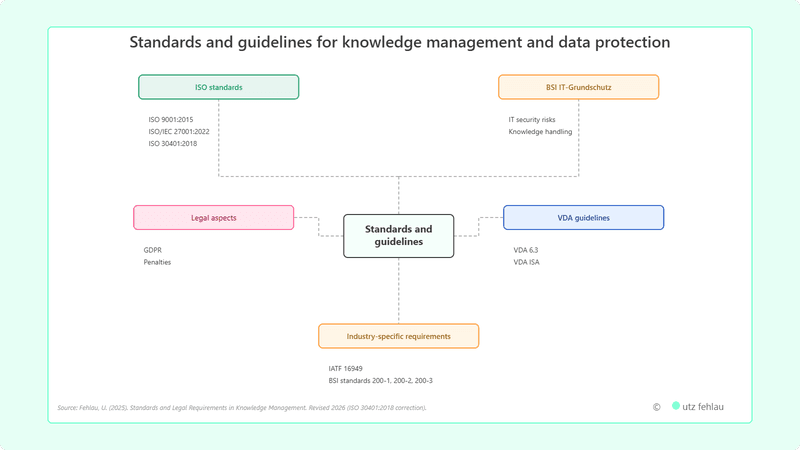
management in SMEs. ISO standards, BSI IT-Grundschutz, VDA guidelines, legal
mandates such as GDPR, and industry-specific requirements connect to one common
framework.4. Standards in Practice
4.3 Information Security and Data Privacy
GDPR hits large and small businesses alike. Any data that identifies a person—like an email address—deserves protection. Knowledge management must align with these laws. That means only authorized users see certain docs. It also means a clear log of who accessed what. Violations can bring steep fines. When you link knowledge management to security frameworks, you reduce these risks.
5. Implementing Standards and Legal Requirements in KM
5.1 Analyze Current KM Practices
Start with a gap analysis. See how your current knowledge management stands versus ISO or GDPR. Gather your process docs, your IT policies, and your user rights list. Look for outdated manuals, missing encryption steps, or vague roles. That sets the stage for change.
Example: A mid-sized firm discovers that half of its job role guides are on an old share drive. Many new hires can't access them. The info also fails to mention new regulations or product lines. They realize they must unify and update these assets.
5.2 Identify Compliance Gaps
Compare your usage patterns with standard guidelines. For instance, ISO 30401 addresses how you store and retrieve knowledge. GDPR addresses how you handle personal data in that knowledge base. If you find a mismatch—like no user logs or no privacy disclaimers—you must fix it.
5.3 Introduce Processes for Documentation, Sharing, and Evaluation
A standard like ISO 9001 encourages detailed but concise process documentation. You also want an easy way to share these docs. Tools like Nextcloud or Confluence can help. They let staff read, edit, or comment without flooding emails.
- Documentation: Write short guides or flowcharts. Keep them updated.
- Sharing: Set user permissions, password-protect external links, and track changes.
- Evaluation: Create a simple feedback loop. If a doc is outdated, staff raise a flag.
5.4 Integrate Industry-Specific Requirements
If you're in automotive, tie your KM system to VDA 6.3 or IATF 16949. That ensures your supplier audits go smoothly. If you're in IT, align with BSI IT-Grundschutz for robust security steps. For each sector, check if there's a specialized standard that references knowledge management. Map your processes to these guidelines so you meet or exceed their demands.
6. Challenges and Solutions
6.1 Typical Challenges
- Staff Resistance — People dislike new rules and fear complexity. They might view standards as red tape.
- Technical Integration — Older systems may not mesh with the newest security frameworks. Migration can cost money and time.
- Volume Overload — Firms might have thousands of files scattered across servers. Sorting them can be daunting.
- Maintaining Compliance — Rules change, especially with evolving privacy laws. A one-off compliance update doesn't last forever.
6.2 Potential Solutions
- Phased Rollout — Don't impose everything at once. Pick a single department or process to pilot.
- Focused Training — Teach employees why these rules matter. Highlight real examples of data breaches or compliance fines.
- Clear Accountability — Assign a "KM Champion." Make them track progress and follow up on tasks.
- Automation Tools — Use scripts or tagging systems to detect stale docs. Deploy workflows that alert managers if no updates occur for six months.
These tactics prevent friction and keep your staff engaged.
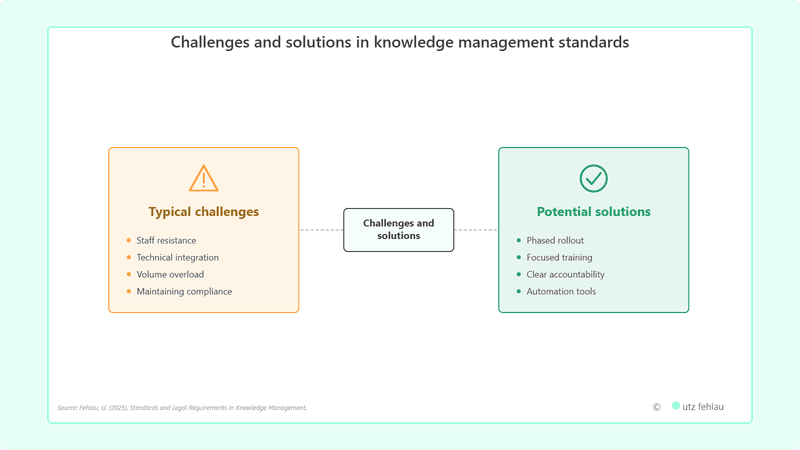
challenges and four matching solution approaches. Staff resistance, technical
integration, volume overload, and ongoing compliance can be addressed through
phased rollouts, training, accountability, and automation.
7. Conclusion: Standards as the Future of Knowledge Management
Knowledge management keeps a firm's expertise alive. Standards like ISO 30401 or ISO 9001 provide structure. GDPR and similar laws add legal weight. Together, they push you to ensure knowledge is correct, safe, and easy to find. If you want a resilient, competitive business, you can't skip these frameworks.
Standards also cultivate trust. Clients, suppliers, and staff see that you respect data privacy. They note your well-documented methods. This paves the way for innovation and stable growth. Compliant knowledge management isn't just about paperwork. It's about raising your entire operation to a higher level of maturity and security.
8. Future Outlook
8.1 Evolving Standards
New guidelines will likely appear for AI and data analytics. As these technologies spread, knowledge management must adapt. We might see extended rules for deep learning models that rely on organizational know-how.
8.2 Heightened Regulatory Attention
GDPR is just one wave. More countries will pass privacy laws, each with unique demands. SMEs should watch these trends to avoid last-minute chaos. Tools that unify compliance encourage minimal duplication, efficient storage, and better resource tracking.
9. Cost Aspects: Is It Worth the Price?
9.1 Cost-Benefit Analysis
Complying with standards takes time, money, and staff effort. You may pay for audits, consultant fees, or software upgrades. Yet ignoring these demands can hurt more. Fines for GDPR breaches can reach millions. A data leak might drive clients away for good. The money spent on compliance can yield a strong return through fewer errors, smoother audits, and happier customers.
9.2 Long-Term Gains
Well-organized knowledge management cuts repeated work. It also helps new hires learn faster. A single compliance fine could dwarf the cost of an ISO-based training course. Over time, a structured approach lowers stress and improves efficiency. That fosters better morale, which in turn boosts retention and performance.
9.3 Strategic Investment
When budgeting, link costs to clear goals. Maybe you aim to reduce product defects by 15% or pass an upcoming industry audit. If managers see how improved knowledge management ties directly to profits or brand image, they'll support the project. Highlight success stories from peers who overcame compliance hurdles. That can sway leadership to invest in ongoing standardization efforts.
10. Call to Action
Ready to align knowledge management with global standards? Start with these steps:
- Check Gaps — Compare your current docs and processes with ISO or BSI guidelines.
- Tackle GDPR — Ensure you store personal data lawfully and safely.
- Adopt a Pilot — Focus on one department to test new policies.
- Monitor Progress — Track staff adoption, doc updates, and compliance logs.
- Share Wins — Show management how these improvements enhance quality and reduce risk.
Have you begun using ISO 30401? Do you see a challenge merging GDPR rules with your KM tools? Share your insights below, and let's shape a future where standards guide us toward success.
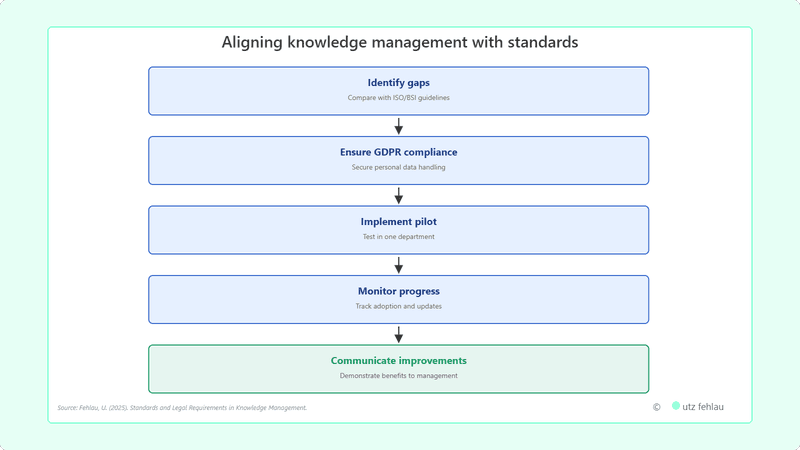
steps, from an initial gap analysis against ISO and BSI guidelines to communicating
demonstrated improvements back to management.
#KnowledgeManagement #ISO30401 #LegalCompliance #SMELeadership #DataProtection
References
Primary sources (standards, regulatory bodies, EU)
- ISO/IEC 27001:2022. Information security, cybersecurity and privacy protection — Information security management systems — Requirements. Geneva: International Organization for Standardization / International Electrotechnical Commission, 3rd edition.
- ISO 30401:2018. Knowledge management systems — Requirements. Geneva: International Organization for Standardization, 1st edition.
- Bundesamt für Sicherheit in der Informationstechnik (BSI). ISO 27001-Zertifizierung auf der Basis von IT-Grundschutz. Bonn: BSI.
- Sartor, G., & Lagioia, F. (2020). The impact of the General Data Protection Regulation (GDPR) on artificial intelligence. Study for the European Parliament, European Parliamentary Research Service (EPRS), Scientific Foresight Unit (STOA). Brussels: European Union.
- Datenschutzkonferenz (DSK) — Konferenz der unabhängigen Datenschutzaufsichtsbehörden des Bundes und der Länder (2019). Das Standard-Datenschutzmodell (SDM), Version 2.0b.
Peer-reviewed journal articles
- Pawlowsky, P., Pflugfelder, N. S., & Wagner, M. H. (2021). The ISO 30401 knowledge management systems standard – a new framework for value creation and research? Journal of Intellectual Capital, 22(3), 506–527. https://doi.org/10.1108/JIC-07-2020-0256
- Culot, G., Nassimbeni, G., Podrecca, M., & Sartor, M. (2021). The ISO/IEC 27001 information security management standard: literature review and theory-based research agenda. The TQM Journal, 33(7), 76–105. https://doi.org/10.1108/TQM-09-2020-0202
- Zieba, M., & Bongiovanni, I. (2022). Knowledge management and knowledge security—Building an integrated framework in the light of COVID-19. Knowledge and Process Management, 29(2), 121–131. https://doi.org/10.1002/kpm.1707
- Carlucci, D., Kudryavtsev, D., Santarsiero, F., Lagrutta, R., & Garavelli, A. C. (2022). The ISO 30401 Knowledge Management Systems: a new frame for managing knowledge. Conceptualisation and practice. Knowledge Management Research & Practice, 20(6), 975–986. https://doi.org/10.1080/14778238.2022.2118637
- Schmitt, U. (2022). Validating and documenting a new knowledge management system philosophy: a case based on the ISO 30401:2018-KMS standard. Knowledge Management Research & Practice, 20(6), 960–974. https://doi.org/10.1080/14778238.2022.2064349
- Zeiringer, J. P., & Thalmann, S. (2021). Knowledge sharing and protection in data-centric collaborations: An exploratory study. Knowledge Management Research & Practice. https://doi.org/10.1080/14778238.2021.1978886
- Corney, P. J. (2018). As KM evolves, so will the ISO standard. Business Information Review, 35(4), 165–167. https://doi.org/10.1177/0266382118810825
- Granata, D., Mastroianni, M., Rak, M., Cantiello, P., & Salzillo, G. (2024). GDPR compliance through standard security controls: An automated approach. Journal of High Speed Networks, 30(2), 147–174. https://doi.org/10.3233/JHS-230080